
MIPI Dual Camera Module | OEM Design for Face Recognition & Liveness Detection
▐ Products Description
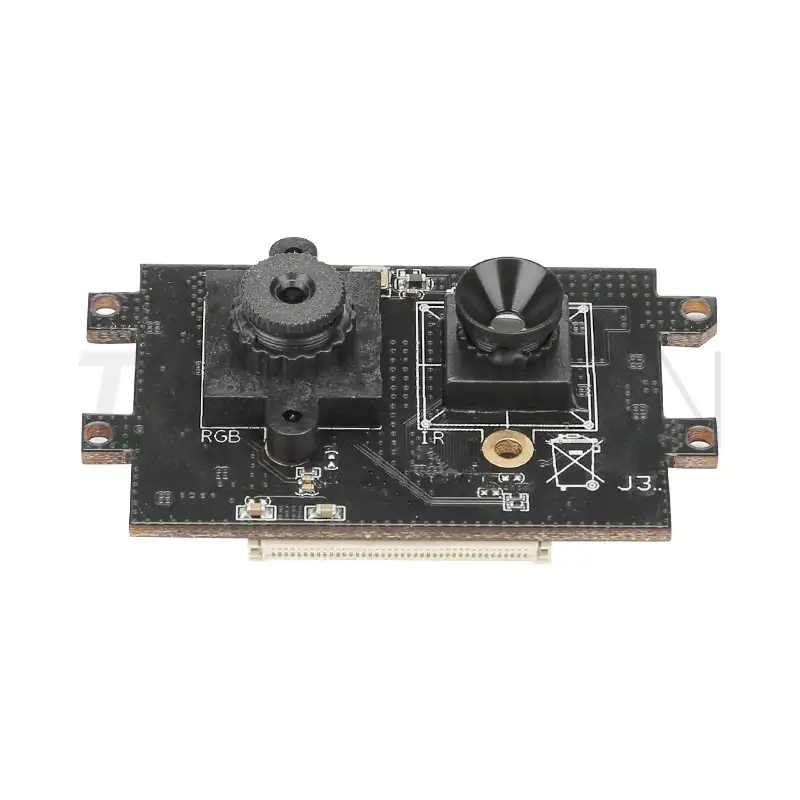
MIPI Dual Camera Module for Face Recognition and Liveness Detection
The TUXIVISION HX398A02M29 is a dual-camera module built around two GC2093 2MP image sensors. Each camera supports up to 1920 × 1080 resolution at 60 FPS, with a fixed-focus lens configuration and an MIPI interface. The paired image streams can serve as the image input for face recognition and liveness detection systems, where camera placement, optical alignment, and synchronization requirements need to be considered at the system design stage.
For a dual-camera design, the host platform is responsible for receiving and processing the MIPI streams and running the required recognition algorithms. Windows, Android, and Linux are listed as supported operating systems; actual operation depends on the target processor, MIPI receiver, driver, and application software. The module itself should not be confused with a complete face recognition terminal or an algorithm-equipped camera system.
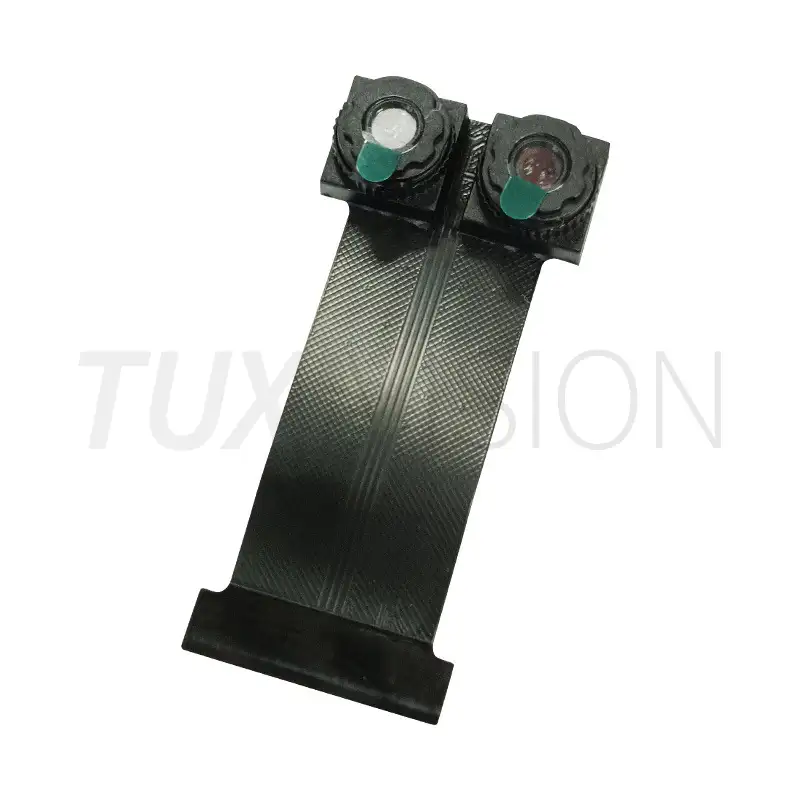
For OEM projects, the 48 mm FPC cable can be customized to suit the host device layout. Image Sensor placement, lens selection, camera spacing, board dimensions, and connector orientation should be reviewed together: changes to any one of these may affect the mechanical fit and the usable stereo image area. Logo customization and other processing customization are also available for project evaluation.
▐ Core Features
Dual GC2093 2MP Image Sensors
1920 × 1080 Resolution at 60 FPS
MIPI Dual-Camera Interface
48 mm FPC Cable, Customizable
▐ Technical Specification
| Item | Specification |
|---|---|
| Application | Face recognition and liveness detection |
| Image Sensor | 2 × GC2093, 2MP per camera |
| Maximum Resolution | 1920 × 1080 per camera |
| Maximum Frame Rate | Up to 60 FPS per camera |
| Interface | MIPI |
| Focus | Fixed focus |
| Supported Operating Systems | Windows / Android / Linux |
| FPC Cable Length | 48 mm; customizable |
| Customization | FPC cable length and product logo; other changes subject to engineering review |
| Power Supply / MIPI Lane Configuration / Synchronization | Not specified; confirm with TUXIVISION for the target platform |
▐ Image Sensor Introduction
This module uses the GC2093 CMOS image sensor in both camera units. Each sensor provides 2MP output, with a maximum resolution of 1920 × 1080 and a specified frame rate of up to 60 FPS. For face recognition and liveness detection, resolution and frame rate are only part of the selection process. The lens field of view, focus distance, camera spacing, relative alignment, and the host platform's ability to receive both MIPI streams all affect the image data available to the algorithm. Specific synchronization behavior and image-processing functions should be confirmed against the target system.
▐ Product Advantages
01
Two Matching GC2093 Image Sensors
Both camera units use the GC2093 sensor, with 2MP resolution per camera. Using the same sensor model gives the system designer a consistent starting point when evaluating the two image streams.
02
Full HD Capture at up to 60 FPS
Each camera supports up to 1920 × 1080 output at 60 FPS. The host processor and MIPI receiver must be able to handle the required data rate from both cameras; achievable frame rate in the finished device also depends on the platform and software pipeline.
03
MIPI Interface for Embedded Platforms
The module connects through MIPI. Before ordering, confirm the host processor's MIPI CSI support, lane configuration, connector pinout, driver availability, and the method used to capture both camera streams. Operating system support alone does not establish compatibility with every board.
04
FPC and Logo Customization
The standard FPC cable length is 48 mm and can be customized. Logo customization is also supported. Other mechanical or electrical changes need to be reviewed against the required mounting space and host-board connection.
▐ Why Choose TUXIVISION for OEM Dual-Camera Projects
Engineering Review Before Sample Approval
A dual-camera module has to fit the host device mechanically as well as electrically. We review the target processor, MIPI interface, camera spacing, lens requirements, and FPC routing before confirming a sample configuration.
Customization for the Host Device
The 48 mm FPC length and product logo can be customized. If the enclosure or mainboard imposes additional constraints, share the available space, connector details, and mounting drawings so the proposed changes can be checked before tooling or sample production.
Prototype-to-Production Coordination
Prototype samples allow the two camera views, focus, mounting position, and host-platform capture to be checked before a production order. Any change to the sensor, lens, FPC, or board layout should be recorded and revalidated against the approved sample.
▐ Face Recognition / Liveness Detection


▐ Certifications & Quality Assurance

ISO 9001

ISO 45001

ISO 14001

EMC Test

CE Certified
▐ FPC Length / Logo / Hardware Configuration Service
The HX398A02M29 is intended for integration into a host device rather than standalone operation. OEM customization can be discussed around the 48 mm FPC cable, logo, camera mounting arrangement, and other project-specific hardware requirements. To assess fit and compatibility, the engineering review should include the target processor, MIPI connection details, available installation space, required camera spacing, lens or field-of-view requirements, operating system, application, and expected quantity.

Lens & Optics
view more

Image Sensor
view more

Mechanical Design
view more

FPC & Connector
view more
▐ FAQ
Q1:What is the HX398A02M29 MIPI dual camera module?
+
-
The HX398A02M29 is a dual-camera module using two GC2093 2MP sensors. Each camera supports up to 1920 × 1080 resolution at 60 FPS and connects through an MIPI interface. It is intended for integration into a host device or embedded vision system.
Q2:Can the FPC cable length or logo be customized?
+
-
Yes. The standard FPC cable length is 48 mm and can be customized. Logo customization is also supported. Other changes should be reviewed with the required dimensions, connector details, and host-board information.
Q3:Which operating systems are supported?
+
-
Windows, Android, and Linux are listed as supported systems. Compatibility still depends on the target processor, MIPI receiver, camera driver, and application software. Please provide the host platform details for a project-level check.
Q4:What should be checked before integrating the two cameras?
+
-
Confirm that the host board supports the required MIPI camera inputs and can process both streams. Camera spacing, lens focus, field of view, mounting position, FPC routing, and the software capture pipeline should also be evaluated on the prototype.
Q5:What information is needed for an OEM quotation?
+
-
Please share the target processor or development board, MIPI interface and connector pinout, required camera spacing, lens or field-of-view requirements, available installation dimensions, FPC length, operating system, application, and estimated quantity. These details help determine whether the standard module is suitable or needs customization.
Hot Tags: mipi dual camera module, China mipi dual camera module manufacturers, 12mp camera vision module, dip camera, h264 output sensor module, professional imaging module, usb webcam 720p camera, with cover sensor module