


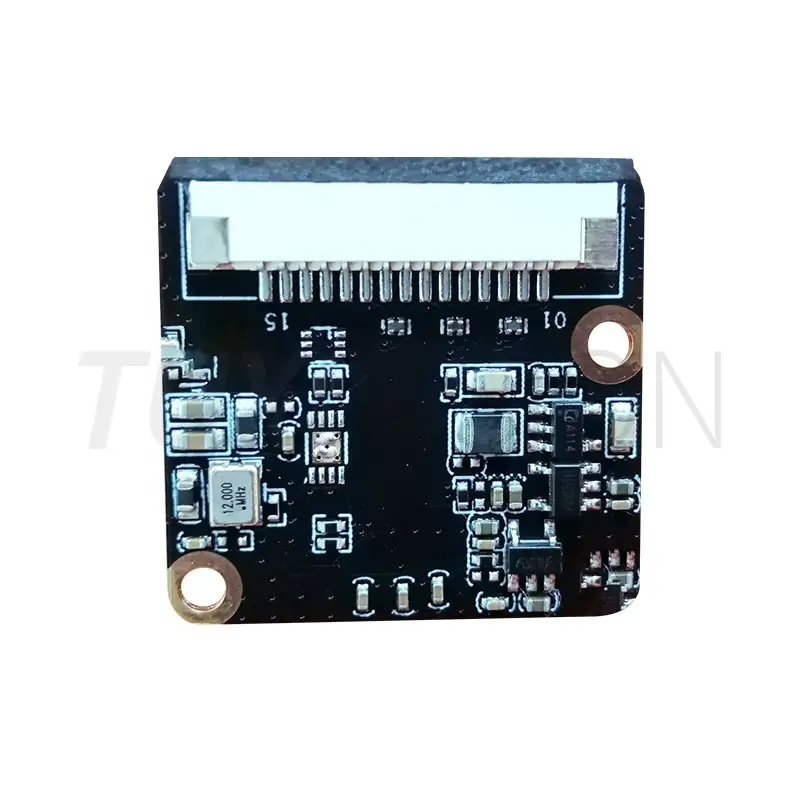
Robot Obstacle Avoidance Camera Module | OV9281 Global Shutter OEM Design
▐ Products Description
OV9281 Global Shutter Imaging for Robot Obstacle Avoidance
The TUXIVISION HX9281RP is a compact monochrome camera module built around the OV9281 CMOS global-shutter sensor. It captures 1280 × 800 images at frame rates up to 120 fps and uses a MIPI CSI-2 output. For mobile robots, this combination is relevant when the vision system must track nearby objects while the platform is moving. A global shutter exposes the image without the row-by-row timing offset associated with a rolling shutter, helping reduce motion-related geometric distortion during fast movement.
The module measures 25 × 24 mm and weighs approximately 10 g, leaving room for integration into compact robot bodies, mobile platforms, and embedded vision assemblies. Its monochrome output and fixed-focus configuration suit projects that prioritize image capture for detection, positioning, or machine-vision processing rather than color reproduction. The module itself is an image-capture component; obstacle-detection algorithms, depth estimation, and navigation decisions are handled by the host processor and application software.
For an OEM design, the lens field of view, working distance, focus position, mounting angle, and camera-to-processor connection should be checked against the robot's actual operating environment. Board placement and cable routing also matter: a suitable sensor can still produce poor results if the lens is obstructed or the module is exposed to vibration or an unsuitable viewing angle. Cable length can be customized; the final cable and connector arrangement should be confirmed against the host board.
▐ Core Features
OV9281 Monochrome Global Shutter
1280 × 800 at up to 120 fps
MIPI CSI-2 Output
Compact 25 × 24 mm Module
▐ Technical Specification
| Item | Specification |
|---|---|
| Application | Robot Obstacle Avoidance / Machine Vision / UAV / Industrial Scanning / Target Positioning |
| Image Performance | Monochrome Imaging / Global Shutter |
| Video Compression | Not specified for the camera module; depends on the host system |
| Network Protocol | Not specified; system-level integration depends on the host platform |
| Audio Interface | Not specified |
| Alarm Interface | Not specified |
| Power Supply | Power requirements to be confirmed |
| Lens Options | Fixed-focus lens; FOV and optical details to be confirmed |
| Customization | Cable length and module integration can be customized; other changes are project dependent |
| Operating Environment | Operating temperature range to be confirmed |
▐ Sensor Introduction
The HX9281RP uses the OmniVision OV9281, a 1/4-inch, 1-megapixel monochrome CMOS sensor with a global shutter. Its 1280 × 800 resolution and frame rate of up to 120 fps give the host vision processor a sequence of images with consistent exposure timing across the frame. This is useful when a robot or UAV is moving and image geometry must remain more stable during capture. The sensor specification alone does not define obstacle-detection range or accuracy; those results also depend on lens selection, illumination, mounting, processing algorithms, and the target platform.
▐ Product Advantages
01
Reduced Rolling-Shutter Distortion During Motion
During movement, a rolling-shutter sensor can capture different image rows at slightly different times. The OV9281 global-shutter architecture avoids that row-dependent exposure timing, which can be valuable for visual tracking and motion analysis. Actual results still depend on exposure settings and the speed of the scene.
02
High Frame-Rate Image Capture
With a maximum frame rate of 120 fps, the module can supply frequent image updates to a compatible host. The achievable frame rate in the finished product must be checked with the selected processor, MIPI receiver, resolution settings, and software pipeline.
03
MIPI CSI-2 for Embedded Vision Platforms
MIPI CSI-2 provides the camera output interface for connection to a compatible embedded vision processor. Lane configuration, connector pinout, signal integrity, and driver support should be verified against the target board before the design is frozen.
04
Compact Mechanical Format
The 25 × 24 mm board and approximately 10 g module weight are useful starting points for space- and weight-constrained equipment. The available installation envelope, lens protrusion, cable exit direction, and fixing method still need to be checked in the customer's mechanical drawing.
▐ Why Choose the HX9281RP for an OEM Project
Check the Complete Imaging Path Before Design Freeze
Camera selection is only one part of an embedded vision design. The lens, field of view, working distance, exposure control, processor input, and image-processing pipeline should be evaluated together. Confirming these items early helps avoid mechanical or interface changes after prototype assembly.
Mechanical and Cable Details Can Be Reviewed
Robot housings often leave little clearance around the camera. Board outline, mounting holes, lens orientation, connector type, and cable length can affect assembly and service access. The cable length is customizable; other mechanical or electrical changes require project review.
Prototype Evaluation Before Volume Production
An engineering sample allows the customer to check image output, frame rate, focus, field of view, cable routing, and compatibility with the target processor. These points should be validated on the actual robot before the configuration is released for volume production.
▐ Application


▐ Certifications & Quality Assurance

ISO 9001

ISO 45001

ISO 14001

EMC Test

CE Certified
▐ Customization Service
For robot obstacle-avoidance projects, the main items to define are the required field of view, detection distance, target size, camera mounting height and angle, operating speed, ambient lighting, host processor, and MIPI CSI-2 connection. The HX9281RP uses a fixed-focus lens; the required FOV and working distance should be confirmed for each installation. Cable length can be customized, while PCB, connector, lens, or other hardware changes are subject to technical review.

Lens & Optics
view more

Sensor
view more

Mechanical Design
view more

Connector & I/O
view more
▐ FAQ
Q1: What makes a global-shutter camera useful for robot obstacle avoidance?
+
-
A global-shutter sensor captures the image frame without the row-by-row exposure timing used by a rolling shutter. This can reduce motion-related image distortion when a robot is moving. Obstacle detection itself is performed by the host processor and software, not by the camera module alone.
Q2: What are the main specifications of the HX9281RP?
+
-
The HX9281RP uses an OV9281 1/4-inch monochrome CMOS global-shutter sensor. Resolution is 1280 × 800, maximum frame rate is 120 fps, output is MIPI CSI-2, and the module measures 25 × 24 mm with an approximate weight of 10 g. It is fixed focus. Cable length can be customized.
Q3: Does the module perform obstacle detection or distance measurement?
+
-
No. The HX9281RP is an image-capture module. Object recognition, obstacle detection, distance estimation, and navigation logic depend on the host processor, additional sensors if required, and the customer's algorithms.
Q4: Which host platforms and operating systems can be used?
+
-
The listed operating systems are Windows, Android, and Linux. Actual integration depends on the host processor, MIPI CSI-2 receiver, driver availability, and software support. The target processor and development environment should be confirmed during evaluation.
Q5: What information is needed to assess the camera for our robot?
+
-
Please share the required FOV, working distance, target size, robot speed, camera mounting position, lighting conditions, host processor, MIPI interface details, cable length, and expected quantity. A mechanical drawing or camera placement image is also useful for checking lens clearance and the viewing angle.
Hot Tags: robot obstacle avoidance camera, China robot obstacle avoidance camera manufacturers, aerial camera imaging module, android compatible camera module, camera catalog camera module, pcb mount usb camera, raw output vision module, reference design webcam


